
A YouTube history of manga in America by Mattt

The opening screen of the YouTube video 'How manga broke the US comic industry' by Mattt. A black background with the title at top right, a circular pie chart in green and grey with small red and blue segments left of centre, and the Marvel and DC logos indicating their approximate current US market share.

Frederik L. Schodt is someone whose own scholarship is impeccable. So when he recommends a piece of work on manga history, it’s work checking out. Mattt’s video is an hour and a half of loving, dedicated and accurate research, conveyed with clarity and passion. “How manga broke the US comic industry” really impressed me. It […]

JAMS Vol 6 issue 1 Open-access anime journal free to read

A screen showing the opening slide of the post-symposium talk on AI and Studio Ghibli. On the left of the screen is Dr. Rayna Denison, on the right Dr. Zoe Crombie. Photo from JAMS Vol. 6 no. 1.

I’m delighted that the proceedings of the Lancaster symposium on transnational anime are now published as an issue of the Journal of Anime and Manga Studies (JAMS), free to read here. There really is something for everyone here, from papers on the nitty-gritty of motion in anime and music in anime to the rise of […]
Studio Ghibli Question Time: are anime feature films considered superior to anime TV series in Japan?

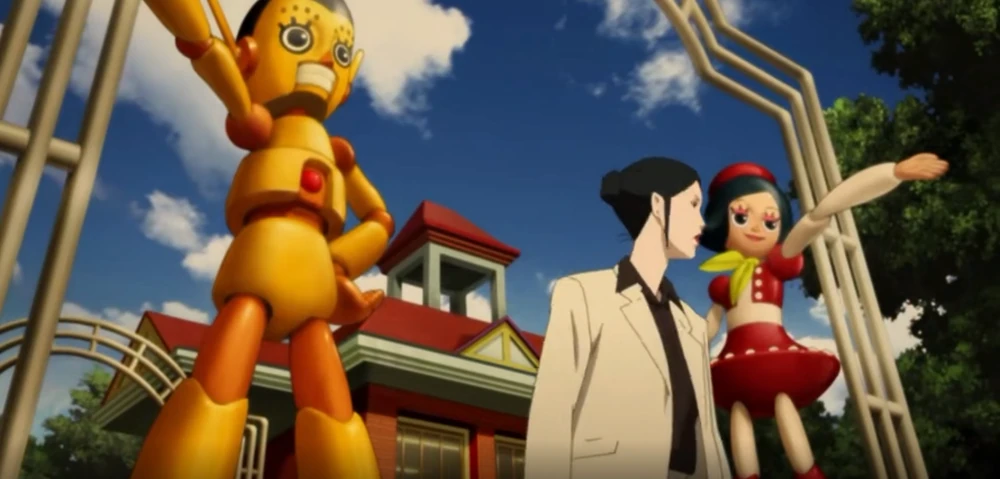
An image from Satoshi Kon's unfinished 5th feature film 'Dreaming Machine'. A young Japanese woman in a beige formal jacket and black open-necked shirt walks under an archway made of gold tubular metal and flanked by two brightly coloured 50s-style characters. A retro-style white house with red roofs is in the background, under a blue sky with fluffy white clouds. The image is slightly unsettling despite the blue sky and bright colours.

Although asked in the context of Miyazaki’s and Ghibli’s views on the primacy of the feature film, this question covers an issue that’s been debated in the anime business  and anime scholarship for decades. It’s a really interesting question, because some people undeniably consider feature films superior to other forms of moving picture, but when […]

Transgenerationality – the ageing up (and ageing out) of Japan’s animation industry

A poster for the symposium on transnational anime held at Lancaster University on 4 July 2025. White text on a blue background, illustrated by the covers of 'Anime: A History" by Jonathan Clements and "Studio Ghibli: an Industrial History" by Ranya Denison. Includes a barcode for more information.

At the beginning of July I was privileged to speak at a symposium on Transnational Perspectives in Anime. It was held on the Lancaster University campus, co-hosted by Dr. Zoe Crombie and Japan Foundation London; I took part from my desktop. It was a truly fascinating day, sparking new ideas and new insights about the […]
Anime going global: the start of the process

The US version of Tetsuwan Atom replaces the Japanese title lettering with "Astro Boy" in a futuristic font

62 years ago, in 1963, 35-year-old Osamu Tezuka flew to the USA to present his hit TV series Tetsuwan Atom to the NBC network. According to Tezuka Production’s history, a preview was screened in New York on 10 March, a contract signed in May, and the series began airing as Astro Boy on 7 September. […]

Studio Ghibli Question Time: What’s the significance of Howl’s exchange of hearts with Calcifer?

The boy Howl swallowing Calcifer's heart in the anime Howl's Moving Castle. This happens late at night in a field outside Howl's study, but his face is illuminated by the fire demon's light.

That’s an excellent question, not just because it impacts a key relationship in the film of Howl’s Moving Castle but because it also gives us an example of the contrast between relationships with an equal power balance and relationships where all power is given to one side. I’m not going to talk about this in terms […]

Studio Ghibli Question Time: what’s in a haircut?

Sheeta from Castle in the Sky, trapped at gunpoint and with her braids literally shot off by her long lost cousin. A half length portrait against a background of thick, greenish-black tree roots. Sheeta weara a high-necked lilac coloured blouse with elbow-length puffed sleeves, a red belt and a red hairband in her dark brown hair.

The Ghibli fans who come to my Seed Talks ask some really interesting questions. So I’ve started recalling as many of them as I can at the end of each session, and I plan to revisit my answers here in a series of news posts, with a bit more detail than I can give in […]

Isao Takahata: FINALLY a book in English

Cover of the book The Many Worlds of Isao Takahata. A warm brown background has a banner image about half an inch below the top of the cover. The image from The Tale of the Princess Kaguya shows Kaguya, a young Japanese woman in an Edo-era pink kimono, laughing as she catches falling cherry blossom petals. The title and author information is below in the same soft pink as her kimono.

The great Isao Takahata, without whom the Hayao Miyazaki we know would not exist, was and remains an influential figure in Japanese animation. Finally, a book in English explores his work and gives a clear picture of how and why he is so highly regarded by directors and animators. Editors Rayna Denison, David Desser and […]

Studio Ghibli Question Time: why does Sophie dress like Yubaba?

A head and shoulders portrait of Sophie Hatter from Howl's Moving Castle in her 90-year-old cursed form. She wears a very old-fashioned blue dress with a high collar and a straw hat with a narrow brim and plum coloured hatband adorned with small pink bobbles.

I get some absolutely fantastic questions from audiences for my Seed Talks on Studio Ghibli. They often raise points I hadn’t thought about before, or give me completely new angles on topics I’ve been over many times. Having let so many of these brilliant insights vanish down Memory Lane I thought I’d try and recall […]
LATEST ON THE NEW EDITION OF “HAYAO MIYAZAKI: MASTER OF JAPANESE ANIMATION”

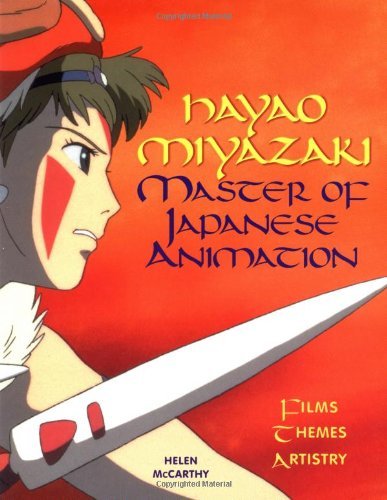
The cover of the 1999 Stone Bridge Press edition of "Hayao Miyazaki: Master of Japanese Animation". On a gradated orange background, a head and shoulders profile image of San wielding her long knife, facing right, with the title to the right above the blade and the subhead and author name below.

Hayao Miyazaki: Master of Japanese Animation was published by Stone Bridge Press in 1999. It was the first book on Miyazaki in English and I had so much fun writing it.  In 2026, over a quarter of a century later, McFarland & Company, Inc., will publish an updated edition covering Miyazaki’s 21st century works. That, […]